

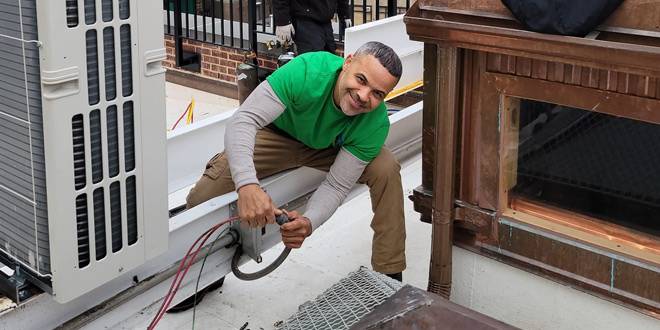
When a heat wave hits, commercial HVAC failures escalate from “inconvenient” to “business-threatening” fast. Tenants complain, employees lose productivity, customers leave, and sensitive equipment can overheat. The best way to handle a commercial HVAC breakdown during extreme heat is to respond quickly, stabilize conditions, and make smart decisions that protect your building now—while reducing the odds of it happening again.
Prioritize Safety and Immediate Comfort First
Heat-related risks can become serious in offices, retail spaces, healthcare settings, and senior living environments. If indoor temperatures are rising quickly:
- Check on vulnerable occupants (elderly, children, anyone with health conditions)
- Provide temporary cooling (portable units, fans, shaded areas)
- Reduce internal heat loads (turn off nonessential lighting and equipment)
- Adjust operations (staggered occupancy, shortened hours, relocating staff)
If your building has server rooms, telecom closets, or refrigeration loads, prioritize those spaces immediately.
Confirm the Problem Before You Call It “System Failure”
A surprising number of “breakdowns” are actually control or power issues. Before placing an emergency call, do a quick triage:
Check power and basic settings
- Verify the system has power (breakers, disconnects, emergency shutoffs)
- Confirm thermostat/setpoints and schedules weren’t changed
- Look for alarms on BAS (building automation) dashboards if you have them
Look for obvious airflow blockers
- Ensure returns and supplies aren’t obstructed
- Check that filters aren’t collapsed or severely clogged (if accessible and safe)
If you manage multiple properties, document which zones/tenants are affected—this helps your HVAC contractor troubleshoot faster.
Call for Commercial HVAC Service Early
During heat waves, response times tighten across New York City and New Jersey because everyone is calling at once. The moment you confirm a loss of cooling capacity, bring in professional help through dedicated air conditioning support.
When you call, have these details ready:
- Building address and access instructions (roof hatch, mechanical room, security contact)
- System type (RTU, split system, VRF/VRV, chiller, etc.)
- What’s happening (no cooling, low airflow, tripping breaker, icing, leaking, loud noise)
- Any recent repairs, outages, or construction impacts
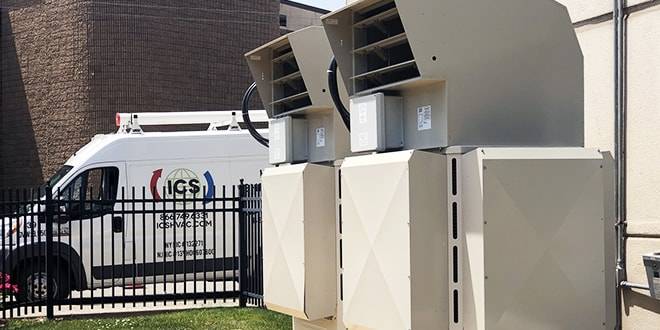
Stabilize the Building While Repairs Are Underway
Even if a technician is en route, you can often reduce heat stress and prevent additional failures:
Reduce peak load
- Raise cooling setpoints slightly in non-critical zones
- Limit heat-generating processes (kitchens, production equipment)
- Close blinds on sun-facing elevations; reduce solar gain
Prevent cascading equipment damage
If a unit is short-cycling, freezing up, or repeatedly tripping, don’t force it to run. Continuous resets can damage compressors and electrical components.
Common Heat-Wave Failure Points to Expect
Understanding typical failure modes helps you communicate symptoms and speed up diagnosis:
- Dirty coils / restricted airflow → reduced capacity, frozen evaporator, high head pressure
- Failed capacitors/contactors → no start, hard starts, intermittent operation
- Refrigerant leaks → weak cooling, longer runtimes, compressor stress
- Economizer/damper failures → overheating zones, poor ventilation, wasted energy
- Overloaded controls/sensors → wrong readings, poor staging, system “fighting itself”
A rapid assessment by an experienced provider—guided by a full services overview—helps determine whether you need a targeted repair, a temporary workaround, or a larger corrective plan.
Use Temporary Cooling Strategically
Portable cooling can keep operations running, but it needs to be deployed intelligently:
- Prioritize lobbies, customer-facing zones, high-occupancy spaces, and critical rooms
- Confirm electrical circuits can handle portable loads safely
- Ensure condensate management and drainage are addressed
- Avoid placing units where they block egress or create trip hazards
Temporary cooling is a bridge—not a fix. Use it to buy time while permanent repairs are completed.
After the Emergency: Prevent the Next Heat-Wave Breakdown
Once comfort is restored, the most important step is follow-through. Heat-wave failures often expose underlying weaknesses. A post-event plan should include:
Schedule preventive maintenance before the next peak
A well-timed tune-up reduces the chance of repeat failures during the next hot stretch. For buildings with heavy cooling demand, align ongoing support with seasonal planning and documented system performance.
Address root-cause issues, not just symptoms
If your building had repeated trips, chronic hot spots, or long runtimes, push beyond “get it running” and pursue corrective action: coil cleaning, airflow balancing, control calibration, economizer repairs, and electrical component replacement.
Evaluate upgrades if failures are recurring
If your system is aging, undersized, or consistently struggling, it may be time to consider higher-efficiency equipment or electrification pathways like heat pump solutions for certain building types and retrofit goals.
Build a Heat-Wave Response Plan for Your Team
Property teams that handle heat waves well have a repeatable process. Consider standardizing:
- Emergency contact list and access instructions
- Tenant communication templates
- Setpoint and scheduling policies during extreme heat
- A priority map of critical zones (IT rooms, medical areas, high-traffic retail)
- Documentation procedures for service calls, readings, and repairs
This turns chaotic outages into manageable events.
Work With a Commercial HVAC Partner Built for High-Demand Conditions
Heat waves don’t just test equipment—they test your response plan and your service partner. Working with Integrate Comfort Systems helps commercial properties across NYC and NJ respond faster, diagnose issues accurately, and reduce repeat failures through smarter planning and system optimization. If you’re dealing with a breakdown now or want to strengthen your heat-wave readiness, contact us today.