
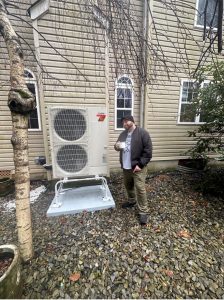
Homeowner Slashes Energy Costs by Switching to Electric Equipment

Elie Elhabr’s rural home was built in 1996 and without access to natural gas, relied on residential fuel oil for heating. Heating oil prices fluctuate, so, when the global price of fossil fuels jumped in 2022, and like many families in New Jersey, the Elhabrs started thinking about replacing their furnace and getting away from dependence on volatile fossil fuels. By the winter of 2023, the family was paying as much as $600 a month on heating bills.

Then, in late 2023, the issue became urgent. The family began to smell fumes from fuel oil in their living space. Fumes can be the sign of a leak and can cause headaches, sore throats and eye irritation which was concerning with two young children at home. Several HVAC firms delivered the same diagnosis, the furnace had developed a crack and had to be replaced – at a price tag of about $14,000. Spending $14,000 to replace the furnace would have tied the family to volatile high fuel oil bills for years to come, so the Elhabrs now had an urgent need to explore converting to electric.

After considering multiple bids, Elhabr decided on a 4-ton Mitsubishi heat pump system installed by Integrated Comfort Systems (ICS). A heat pump system would not only replace the oil furnace but also replace the family’s central air conditioning unit. Similar to the prior air conditioner, the new installation included an outdoor condenser, an indoor air handler and utilizes the home’s existing ductwork.
Elhabr noted that the new system was much quieter than the old one—no more loud fans—and the system maintained consistent temperatures throughout the home. In both summer and winter, they simply don’t have to think about their system. As someone already wary of combustion appliances, the idea of a safer – and healthier – heating solution also appealed to him.
The total cost of the installation, including electrical work, came to $24,000. To reduce the upfront cost gap, the family took advantage of several incentives.
– A $1,000 rebate from New Jersey’s energy efficiency program
– A zero-percent interest loan for $15,000 provided by JCP&L available for Energy Star-certified upgrades
– A $2,000 federal tax credit, which will be refunded on their 2025 tax bill.    

Factoring in these incentives, the net cost to the family was $21,000, about $7,000 more than replacing their fuel oil furnace. Lower energy bills are already closing the cost gap. Based on 2024 energy bills, the family is seeing annual savings of $2,300. At this rate, their additional $7,000 up front investment will be recouped within three years. Enthused by initial cost savings and comfort in their home, the Elhabrs continue to look for ways to electrify. Next up was replacing the family’s old propane stove with an stove—a highly efficient, safe, and healthy alternative. Unlike gas and propane stoves, which emit heat through combustion, induction stoves use electromagnetic fields to heat pots and pans directly, providing faster cooking times and better temperature control. Adopting highly efficient electric appliances isn’t just good for your wallet, it’s better for your family’s health. One study found that kids who live in homes with gas stoves have 42% higher risk of developing asthma symptoms, while another attributed gas stoves to 12.7% of childhood asthma cases across the U.S. Gas stoves have also been found to emit benzene, a cancer-causing chemical, at rates higher than having a smoker in the home. Researchers have found benzene leaking from gas stoves even when turned off. 

By choosing to electrify the Elhabrs not only eliminated their dependence on oil but also improved their family’s comfort and safety. With significant long-term savings and a cleaner, more efficient heating and cooling system, the Elhabr family is a prime example of how homeowners can benefit from transitioning to energy-efficient, electric equipment.   

  • Case Study Credit: Taft Communcation